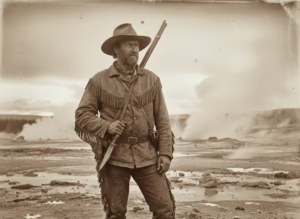
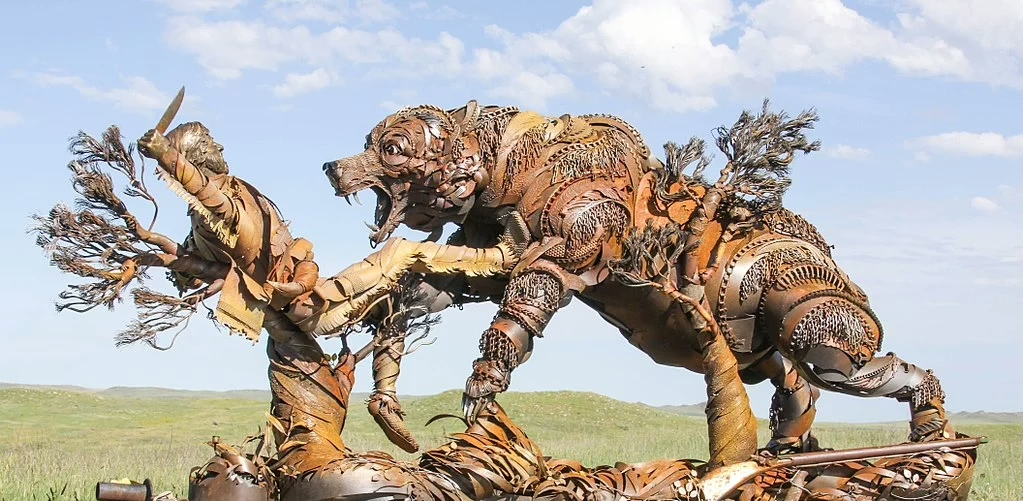
In mountain man circles, Hugh Glass was synonymous with grit long before Hollywood and Leonard DiCaprio made him a household name in The Revenant. Glass’s 200-mile journey for help after being mauled by a grizzly and left for dead by his “companions” is precisely how mortal men become mythical legend. His famous 1823 encounter with that bear left him mangled, abandoned, and stripped of his gear, miles from civilization. Then, he crawled 200 miles through hostile territory, cementing his status as the ultimate survivor of the Rocky Mountain Fur Company era.
Hugh Glass’s Early Life: Pirate, Pawnee Warrior, and Trapper
Born around 1783 in Pennsylvania, Glass’s early life was the perfect, terrifying apprenticeship for the Western frontier.
From Privateer to Pawnee Captive
In the early 1800s, Glass was forced to be a pirate with Jean Lafitte in the Gulf of Mexico. Rather than walk the plank, he was allegedly forced into servitude as a privateer for two rough years. He and a companion escaped near Galveston, where they were captured by the Pawnee in Kansas. Glass watched as the Pawnee impaled and burned his friend alive, and Glass gave a gift of cinnabar (a bright red mercury ore) to the Chief. This saved his life, and he actually fought alongside the Pawnee against neighboring tribes.
Joining Ashley’s Hundred and the Rocky Mountain Fur Company
By 1823, Hugh Glass made his way to St. Louis, the final civilized stop before the unknown West. He signed on with General William Ashley’s major trapping venture, an outfit known as Ashley’s Hundred, which headed up the Missouri River. This company would become the powerful Rocky Mountain Fur Company.
It was in this group that Glass met two men who would ensure his eternal fame: Jim Bridger, a young man barely 19 years old, and John Fitzgerald, another fellow trapper. The expedition had already survived a brutal attack by the Arikara tribe when, while traveling overland in modern-day South Dakota, Hugh Glass’s destiny came calling.
The 1823 Grizzly Bear Attack: A Battle to Live
The year was 1823, the month was August, and the location was near the Grand River, in northwest South Dakota. Hugh Glass, out scouting for game, stumbled into a female grizzly bear and her two cubs.
The Attack on the Grand River
The attack was sudden, brutal, and terrifyingly complete. Glass was unarmed or at least unable to use his bring his weapon. The bear, likely defending her young, mauled him relentlessly. Historical accounts describe him as having a torn scalp, a broken leg, and deep lacerations all over his body. It’s a miracle that any man survived the sheer physical trauma.
The commotion brought other trappers running, and they finally managed to kill the sow, but not before Glass was left seemingly beaten beyond repair. His wounds were so grievous that the other men didn’t expect him to last the night.
Left for Dead: A Gut-Wrenching Betrayal
General Ashley faced a dilemma: The group was deep in hostile territory, specifically the land of the Arikara, and they couldn’t afford to carry a dying man. Ashley offered a reward to any two men who would stay behind, wait for Glass to die, and give him a proper burial.
Jim Bridger and John Fitzgerald volunteered. They stayed, allegedly digging Glass’s grave, but after just three days, they abandoned him. They didn’t just leave; they took his few possessions, including his rifle, knife, and ax. They told the others that Glass had died. Glass, still barely conscious, awoke to find himself alone, defenseless, and stripped of the tools he needed to survive.
The 200-Mile Crawl: A Saga of Human Endurance
Hugh Glass was not just injured; he was a walking corpse. He was abandoned with no gun, no map, no medical supplies, and surrounded by hostile Native American tribes and hungry wildlife. His target: Fort Kiowa, 200 miles away.
An Impossible Journey to Fort Kiowa
His journey became the stuff of legend. He couldn’t walk, so he crawled. He set his own broken leg. He dragged himself along the Grand River for weeks. His only other option was to die.
Historians report that Glass used a rotting log to carry himself across the river and allowed maggots to clean the dead, infected flesh from his back to prevent gangrene. He survived on wild berries, roots, and occasionally, the meat from a carcass left by wolves.
He eventually stumbled across a few friendly Sioux who helped him for a while, but the bulk of the 200-mile crawl was done alone. It took him six grueling weeks before he reached the safety of Fort Kiowa. He wasn’t looking for rescue; he was looking for vengeance.
Seeking Vengeance: The Confrontation and Forgiveness
After healing, the first order of business wasn’t rest—it was finding the trappers who had left him for buzzard meat.
Reunited with Jim Bridger
Glass eventually tracked the younger Jim Bridger down at Fort Henry at the mouth of the Yellowstone River. Bridger, upon seeing the man he thought he’d left in a shallow grave, was reportedly terrified.
In a move that defined Glass’s moral code, he spared the young man. Glass saw Bridger as a misguided youth pressured by an older man, and he likely realized he couldn’t kill a boy without a gun anyway. Instead, he gave Bridger a tongue-lashing that was probably worse than any bullet.
Tracking Down John Fitzgerald
The real target was John Fitzgerald, who had not only left Glass but had stolen his prized rifle. Glass tracked Fitzgerald all the way to Fort Atkinson, only to find that Fitzgerald had joined the U.S. Army.
Glass was faced with a dilemma. He could not kill a U.S. soldier without facing a firing squad. Instead of murder, Glass settled for a measure of justice. He recovered his stolen rifle and received symbolic compensation—roughly $300—for the stolen gear and the trauma. The quest for revenge ended not with bloodshed but with the recovery of his property and dignity.
Hugh Glass & The Revenant: Separating Fact from Hollywood Fiction
The 2015 film The Revenant is a stunning piece of cinema, but it’s a brutal distortion of the historical facts. If you’re looking for the historical accuracy of the Hugh Glass story, here are some of the biggest differences:
| Hollywood Fiction | Historical Fact |
| The Son: Glass has a half-Pawnee son named Hawk whose death fuels the revenge plot. | Glass had no known son on the expedition. The entire revenge motive in the film is fictionalized. |
| The Kill: Glass eventually tracks and kills Fitzgerald in a savage, bloody knife fight. | Glass tracked Fitzgerald down but spared him because he was protected by the U.S. Army. Glass got his rifle back instead. |
| The Timeline: The revenge pursuit is compressed into a tight, intense hunt. | The entire episode, from mauling to the recovery of the rifle, took years—not a single season. |
| The Bear: Glass kills the bear himself. | The sow was killed by the other trappers, who rushed to his aid after he was mauled. |
An Awesome Video on Hugh Glass…thanks to Weird History
The Final Expedition: The Death of Hugh Glass
After his famous ordeal, Glass continued the dangerous life of a mountain man. He scouted, trapped, and guided, knowing full well that death lurked behind every lodgepole.
How Did Hugh Glass Finally Die?
The man who cheated death numerous times was finally taken in 1833. Glass was trapping with two fellow trappers, Edward Rose and Hilkiah Menard, on the Yellowstone River, near the mouth of the Powder River.
The trio was ambushed and killed by a raiding party of Arikara warriors—the very tribe that Ashley and his men had feared ten years earlier. Glass, the man who stared down a grizzly and crawled across a state, met his end in a skirmish with the most feared tribe of the Northern Plains. His fate was hard, unforgiving, and perfectly in line with the legendary, lethal life of a true mountain man.