
1799-1831
It seemed like the West had a grizzly bear behind every lodgepole pine in the early days. One nearly killed Hugh Glass, and another almost ate Jedediah Smith alive. Jedediah Strong Smith was born in what is now Bainbridge, New York, in 1799. As a young boy, he learned to hunt and fish in the forests of Upstate New York and Pennsylvania. However, Smith’s family was constantly on the move, following the steady flow of settlers to the West. It was in the West that Smith would become one of the nation’s greatest explorers. During his life, he traveled through and mapped more territory than any other mountain man. He left behind a journal that chronicled his life from 1822-1828. Few mountain men of the time could barely read, let alone keep a journal. Andrew Garcia and his book Tough Trip Through Paradise are the exception.
The 1823 Grizzly Attack and the Scars that Remained
Smith and around a dozen men were meandering down the south fork of the Cheyenne River when a sizeable grizzly burst from the shadows. It broke ribs and slashed Smith’s belly and chest, eventually putting all of Smith’s head in his mouth. Things looked bleak when the smoke cleared, and the bear retreated thanks to Smith’s men. With scalp and one ear nearly ripped clean off, Smith was stitched up by a fellow trapper, Jim Clyman. After ten days and many stitches, Smith decided it was time to break camp and move on. He and his men continued through the Mojave Desert and California. Thanks to that bear, he continued to explore and keep his hair long to cover his mangled memento for seven more years. In the end, a group of Comanches likely killed him near present-day Kansas.
Rediscovering South Pass (key to the Oregon Trail)
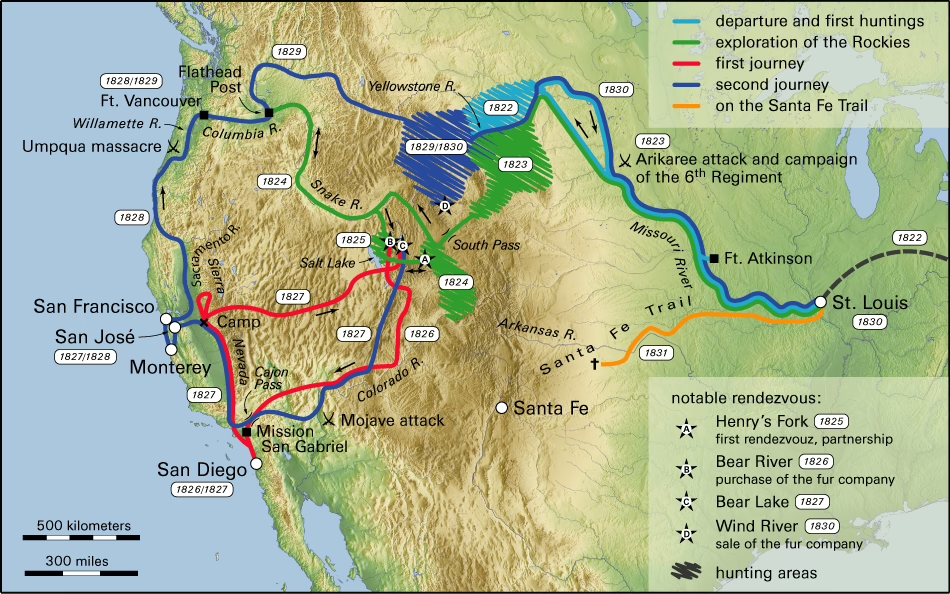
In 1824, Jedediah Smith, along with his partners, made one of the most vital geographic “rediscoveries” in American history: South Pass in present-day Wyoming. While already known to Indigenous peoples and first used by white explorers in 1812, Smith’s documentation and frequent use of the route proved it was the most accessible and gentle crossing of the Continental Divide. Located near the headwaters of the Sweetwater River, the low, broad gap offered a wagon-friendly passage that bypassed the dangerous, high-altitude peaks of the Rocky Mountains. Smith’s success in traversing and promoting this route was instrumental, as it soon became the single most important highway for westward migration, eventually known as the Oregon Trail, leading hundreds of thousands of pioneers to the Pacific Northwest.
First American to Travel Overland to California
Driven by a quest for new beaver trapping territories, Smith pushed the boundaries of the known American West. In 1826, Smith led a small party from the Great Salt Lake, across the vast and punishing Mojave Desert, and into Mexican California. By November 1826, his exhausted but intact party reached the San Gabriel Mission near present-day Los Angeles, becoming the first Americans ever to reach California overland from the eastern United States. This monumental journey effectively opened the door for future American trade and settlement in the Southwest. His travels and maps provided the U.S. government with some of the first reliable geographical intelligence about the uncharted regions between the Rockies and the Pacific Coast.
First American to Cross the Sierra Nevada
After being detained and released by suspicious Mexican authorities in California, Smith found himself faced with a monumental challenge: returning east. In the spring of 1827, unable to travel north up the coast, Smith struck out directly east with only two companions, aiming for the Utah rendezvous point. This decision led to one of his most incredible feats: becoming the first American to cross the Sierra Nevada. Trapped by the immense snowpack and rugged terrain, the crossing was grueling. After reaching the other side, Smith then had to endure a horrific 11-day trek across the Great Salt Lake Desert to rejoin his partners.
Tragically, in 1831, on what was intended to be his last expedition, a group of Comanche Warriors killed Smith. Today, a stone marker commemorating Smith’s life stands in Pathfinder Park in Bainbridge, not far from where Smith’s family home once stood.